Agroforestry and Bird Diversity
How effective is Silvo-arable agroforestry at improving bird diversity?
Introduction
Rising crop demand is increasing the destruction of forests that are carbon sequestrators and vital providers of food and shelter for a variety of birds. Monocultural farming often involves unsustainable practices, creating unsuitable environments for survival. Alternative methods have been developed subsequently, including silvo-arable agroforestry (SAF) where trees are planted alongside crops, aiming to improve biodiversity while maintaining yield.
Results
Discussion
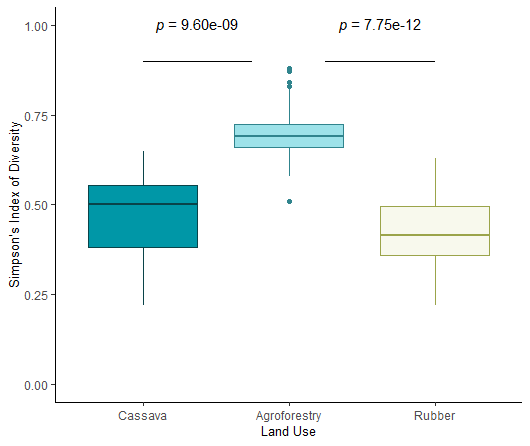
Fig. 1 shows a significantly higher diversity index in agroforests compared to cassava and rubber plantations, both of which are primarily monocultural. This suggests managing a combination of crop and tree species promotes bird diversity. Despite providing shelter, rubber plantations fail to support bird biodiversity. Researchers found in a rubber plantation, 80% of Pellorneum fuscocapillus with a preference for understory failed to return to their capture origin whereas in a forest reserve, 100% successfully returned (Dayananda et al. 2024). Plantations have been found to consistently act as barriers, disrupting animal movement. This highlights the importance of conserving natural forests to protect the 66% of wild birds that can’t thrive in plantation territories (Sreekar et al., 2016). Cassava monocultures create a harsh environment for birds. Farming requires extensive land clearing and tillage, influencing habitat and food availability. Over-tillage results in compacted, dry soil, leading to a loss of soil-dwellers (e.g. earthworms, a key food source for birds) which cannot thrive in these conditions (Soil Quality Institute, 2001). However SAF is predicted to reduce soil erosion up to 70% (Palma et al., 2007), in turn increasing availability of food sources, aiding in population maintenance. Maintaining bird species richness provides economic benefits to farmers; wild birds can reduce crop damage and pest populations while increasing yield (Díaz-Siefer et al. 2021), reducing pesticide needs while boosting productivity. In conclusion, agroforestry is key to improving bird biodiversity. By establishing more habitat layers (e.g. canopy, understory, ground cover), agroforests provide a range of niches for various birds to occupy, benefitting farmers and surrounding wildlife.
References
Dayananda, Salindra K, et al. “Rubber Plantations Are Impermeable to an Avian Understory Specialist in Sri Lanka.” Movement Ecology, vol. 12, no. 1, 17 June 2024, https://doi.org/10.1186/s40462-024-00484-8. Accessed 17 Mar. 2025
Villard, Marc-André, and Samuel Haché. “Conifer Plantations Consistently Act as Barriers to Movement in a Deciduous Forest Songbird: A Translocation Experiment.” Biological Conservation, vol. 155, Oct. 2012, pp. 33–37. ScienceDirect, https://doi.org/10.1016/j.biocon.2012.06.007. Accessed 17 Mar. 2025
Sreekar, Rachakonda, et al. “Effects of Forests, Roads and Mistletoe on Bird Diversity in Monoculture Rubber Plantations.” Scientific Reports, vol. 6, no. 1, 23 Feb. 2016, https://doi.org/10.1038/srep21822. Accessed 17 Mar. 2025.
Steponavičienė, Vaida, et al. “Soil Water Capacity, Pore Size Distribution, and CO2 Emission in Different Soil Tillage Systems and Straw Retention.” Plants, vol. 11, no. 5, 24 Feb. 2022, pp. 1–14. MDPI, https://doi.org/10.3390/plants11050614. Accessed 17 Mar. 2025.
Soil Quality Institute. Agricultural Management Effects on Earthworm Populations. USDA, June 2001. Accessed 17 Mar. 2025.
Palma, J.H.N., et al. “Methodological Approach for the Assessment of Environmental Effects of Agroforestry at the Landscape Scale.” Ecological Engineering, vol. 29, no. 4, Apr. 2007, pp. 450–462, https://doi.org/10.1016/j.ecoleng.2006.09.016. Accessed 17 Mar. 2025.
Díaz-Siefer, Pablo, et al. “Bird-Mediated Effects of Pest Control Services on Crop Productivity: A Global Synthesis.” Journal of Pest Science, vol. 95, no. 2, 27 Sept. 2021, pp. 567–576, https://doi.org/10.1007/s10340-021-01438-4. Accessed 17 Mar. 2025